 (231) 944-6541
 West:

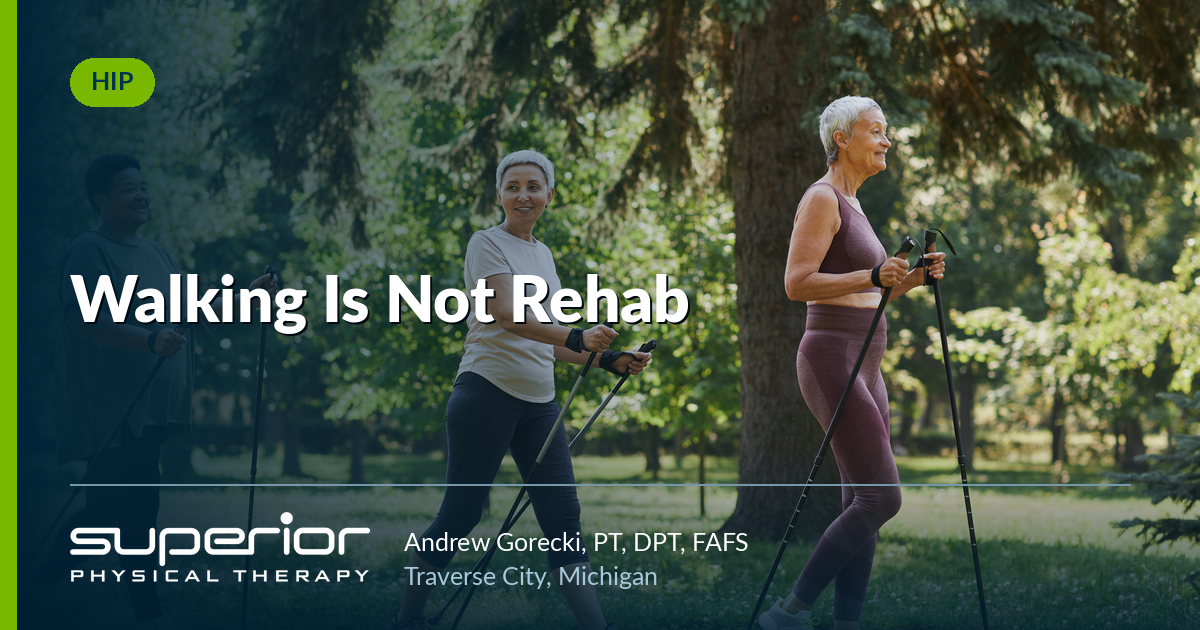
Six months out from his hip replacement, a man told me he was walking three miles a day. Every day, rain or shine, out on the TART before breakfast.
He was still limping.
He knew it, too. His wife had pointed it out. He figured the answer was more miles, so he added a mile, and the limp got a little worse and his outer hip started aching by mile two.
I want to say something about that man before I take his plan apart. He had done every single thing he was told to do, for six months, in a Michigan winter, without anyone checking on him. That is more follow-through than most people manage with a habit they enjoy.
He was also doing the wrong work, and nobody had told him.
Walking is good for your heart, your head, your blood sugar, and your bones. Nobody should stop walking. But walking will not rebuild what a bad hip took from you, and in some cases it makes the pattern more permanent.
The muscle nobody talks about
On the outside of your pelvis, running from the top of your hip bone down to the bump on the side of your femur, is a muscle called the gluteus medius.
Its job is not to move you forward. Its job is to keep you level.
Stand on one leg. Right now, wherever you are reading this. The reason your pelvis does not tip over toward the lifted side is that the gluteus medius on your standing leg is holding it up. And when you walk, you are on one leg roughly 40% of the time. Every single step is a small one-legged stance, and that muscle catches you on each one.
When it is weak, the pelvis drops on the swing side, your trunk lurches over the standing leg to compensate, and you get what looks like a limp. The technical name for that lean is a Trendelenburg gait. The everyday name is "you still walk funny."
What the research found
There is a review published in the Journal of Arthroplasty in 2021 that pulled together 19 studies covering 875 people, looking specifically at hip abductor strength around hip replacement.
Two findings are worth your time.
The first is what people looked like before surgery. Patients scheduled for a hip replacement had an average abductor strength deficit of 18.6% compared with control subjects. That is not a small gap and it did not appear on the operating table. It built up over the years the hip was hurting, while the person unconsciously stopped loading that side.
The second is how slowly it came back. Strength improved after surgery, roughly 20% by four to six months and around 30% by nine to twelve months compared to where people started. Improvement kept going out toward the two-year mark, though the estimates at that end were imprecise enough that the authors were careful not to claim a full recovery had occurred.
Read that again. The gradual recovery in those studies happened over months and years, not weeks. And the reviews could not say the deficit fully closed.
That is the honest picture. Your new hip does not come with new muscle.
Why more walking does not fix it
Because your nervous system is not trying to walk well. It is trying to walk with the least discomfort available.
For two or three years before your surgery, every step you took was solving a problem: how do I get across this room without provoking the hip. Your body found an answer. Shorten the step on that side. Do not push off. Let the trunk lean over. Recruit the low back and the opposite leg to carry the difference.
That answer got rehearsed thousands of times a day for years. It is not a habit at that point. It is wiring.
Now you walk three miles. What you are doing is running that same compensated pattern another five or six thousand times, at a level of effort low enough that the weak muscle is never actually challenged. You are not building the glute. You are practicing walking without it.
There is a second problem, and it is the one I think matters more. Walking on a flat trail is almost entirely a forward and back activity. The gluteus medius does its work sideways. You can log a thousand miles going straight ahead and never once ask that muscle for anything hard, because you are only training in the direction the muscle does not live in.
Muscle responds to what you ask of it. Ask it for easy forward motion and it will deliver exactly that, forever.
What to do about it
Keep walking. I am not asking anybody to give up their three miles, and if the walk is the best part of your day, that is a good enough reason on its own. Add these on top of it, two or three days a week, with enough resistance that the last few repetitions are genuinely difficult.
- Single-leg stance work, done with attention. Stand on the surgical leg in front of a mirror and watch the pelvis. If the opposite hip drops, that is the problem in front of you. Hold level for 30 seconds. Then hold level while you reach the free leg out to the side, which forces the standing glute to work harder.
- Lateral step-downs. Stand on a low step on the surgical leg and slowly lower the other heel toward the floor beside the step, keeping the pelvis level and the knee tracking over the middle of the foot. Slow down is the whole exercise. Eight to twelve of these will tell you plenty.
- Side-lying or banded abduction, taken to real fatigue. Two sets where the last three repetitions are hard. Not thirty easy ones.
- Load sideways and load in rotation. Side steps with a band around the thighs, lateral lunges, a step-and-turn while you carry a heavy bag in one hand. Life happens in three directions and rehab usually only trains one of them.
Ask someone to film you walking from behind on your phone. Twenty seconds. Most people have never seen themselves walk and it is the single most useful thing you can look at.
If the outside of your hip is sharply painful to lie on at night, or if you have real weakness rather than just a limp, get it looked at before you load it hard. A gluteal tendon problem needs a different progression than plain weakness.
The bottom line
Walking is good for you and I want you doing it. It is not the same thing as rehab and it never was.
A joint replacement is a repair to hardware. The muscle deficit that got you into the operating room is still there when you come out, and the research says it takes a long time to close, if it fully closes at all.
Three miles a day of the old pattern will keep the old pattern. An honest twenty minutes of hard, sideways, single-leg work twice a week will start to change it.
Whether that trade is worth it to you is yours to decide. Some people read this and go add two sessions a week. Some read it and decide the walk is enough, and they are living their life, not mine.
Still limping months after a hip replacement, or noticing your hip drop when you stand on one leg? That is worth twenty minutes. Your first visit here is a free movement assessment, in clinic, where we look at all three directions your body moves in rather than just forward and back. That is the Applied Functional Science approach out of the Gray Institute, and it is what every therapist here is trained in. No charge, no insurance, no pressure to book anything after. Call the West Front St office at (231) 944-6541.
You can also pick up a free copy of my hip replacement recovery book at thesuperiortherapy.com.