 (231) 944-6541
 West:
West: 
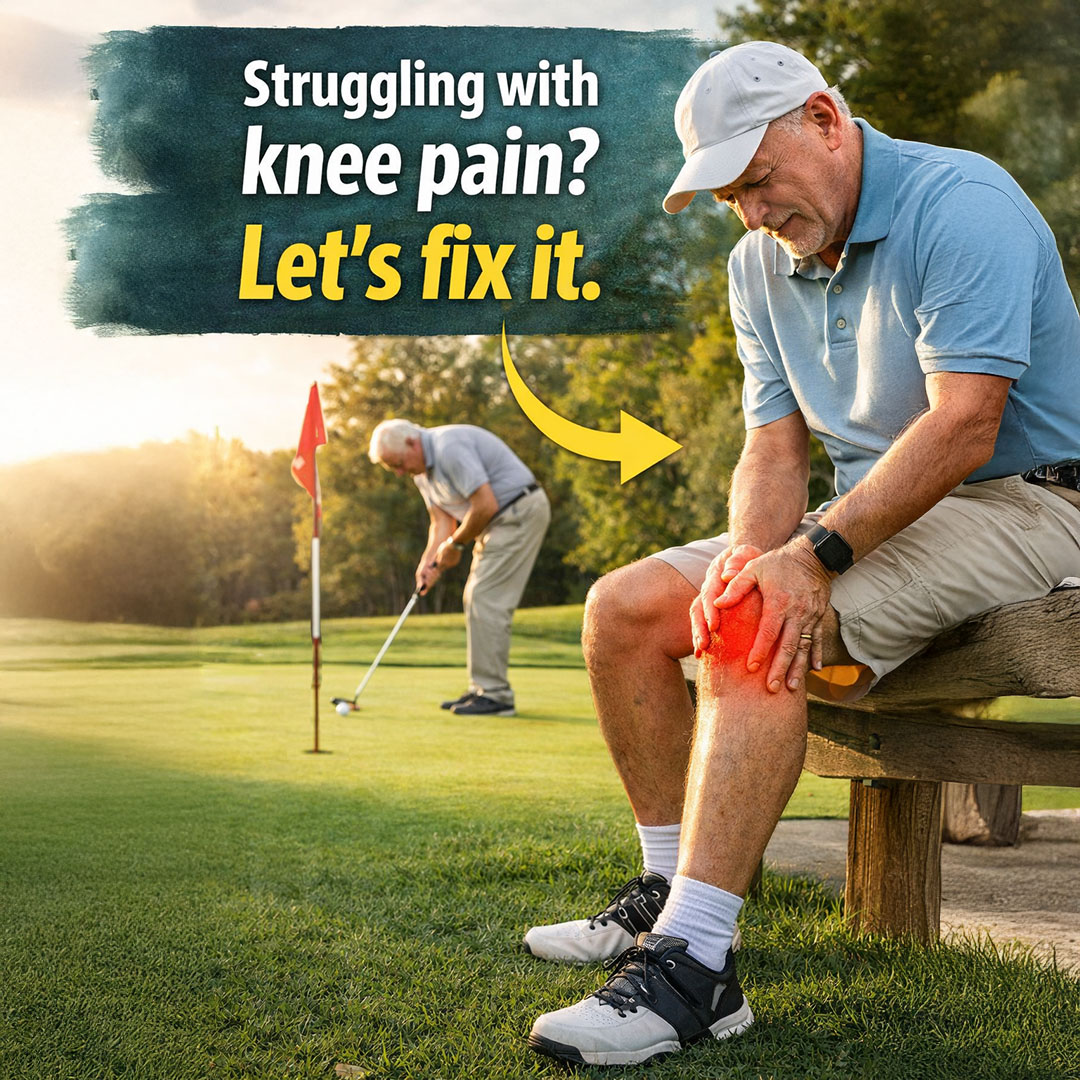
Walking the Greens Without Pain: Solutions for Knee Pain in Golfers
There’s something timeless about walking the course—the rhythm of your steps between shots, the quiet anticipation before a swing, the connection between your body and the game. But when knee pain enters the picture, that rhythm is disrupted. What once felt effortless can become a calculated, uncomfortable journey.
For many golfers, knee pain doesn’t arrive all at once. It builds slowly—step by step, swing by swing—until it can no longer be ignored.
Golf may not look like a high-impact sport, but the forces placed on the knee are significant. Rotational stress during the swing, uneven terrain, and repetitive walking all combine to challenge the joint.
Three conditions show up again and again:
Meniscus Tears: When Rotation Becomes Irritation
The meniscus is a shock-absorbing cartilage in your knee. During a golf swing—especially the follow-through—your knee experiences rotational forces that can strain or tear this structure.
Common signs:
-
Pain with twisting or pivoting
-
Clicking or catching in the knee
-
Swelling after a round
The real issue:
It’s often not just the meniscus—it’s how your body moves. Limited hip mobility or poor foot mechanics can shift excessive rotational stress directly into the knee.
Knee Arthritis: When Wear and Tear Meets Movement Dysfunction
Arthritis is commonly described as “wear and tear,” but that’s only part of the story. Many golfers with arthritis can still play pain-free—if their movement patterns support the joint instead of stressing it.
Common signs:
-
Stiffness, especially in the morning or early holes
-
Aching pain during or after walking the course
-
Reduced range of motion
The real issue:
Arthritic knees don’t tolerate poor mechanics well. When the hips, ankles, and core aren’t doing their job, the knee absorbs forces it was never meant to handle alone.
Tendonitis: When Repetition Becomes Overload
Tendonitis—often involving the patellar tendon—develops from repetitive stress without adequate recovery or support.
Common signs:
-
Pain just below the kneecap
-
Discomfort with walking hills or stairs
-
Tenderness with pressure
The real issue:
The tendon is being overloaded because other parts of the body aren’t sharing the work efficiently.
The Missing Link: It’s Not Just Your Knee
Here’s the truth most golfers never hear:
Your knee pain is often a movement problem—not just a tissue problem.
The knee sits between the hip and the foot. It depends on both for proper function. If either one is restricted, unstable, or poorly coordinated, the knee becomes the “compensator.”
That’s where Applied Functional Science (AFS) changes everything.
Why Applied Functional Science Physical Therapy Works
Traditional approaches often focus only on the site of pain:
-
Rest
-
Ice
-
Medication
-
Generic strengthening
These may provide temporary relief—but they don’t address why the pain started.
Applied Functional Science Physical Therapy takes a different approach.
It asks:
-
How does your body move during your golf swing?
-
How do your hips rotate?
-
How does your foot interact with the ground?
-
Where are you compensating?
From there, treatment becomes highly specific, purposeful, and effective.
What Makes This Approach Different?
1. It Treats the Whole Chain
Instead of isolating the knee, AFS evaluates and treats the entire movement system—foot, ankle, knee, hip, pelvis, and trunk.
2. It Uses Real Golf Movements
Exercises aren’t random—they mimic the demands of walking the course and swinging a club.
3. It Restores Efficiency
By improving mobility, stability, and timing, stress is redistributed away from the knee.
4. It Builds Resilience
You don’t just feel better—you become a stronger, more efficient golfer.
What Recovery Can Look Like
With the right plan, many golfers experience:
-
Less pain during and after rounds
-
Improved walking endurance
-
Better balance on uneven terrain
-
Increased power and consistency in their swing
And perhaps most importantly…
Confidence.
Confidence to walk all 18 holes.
Confidence to rotate freely through your swing.
Confidence that your body will support your game—not limit it.
A Better Way Forward
Knee pain doesn’t have to mean fewer rounds, a golf cart, or giving up the game you love.
When you understand the true cause—and address it with a movement-based, science-driven approach—you give your body the opportunity to heal, adapt, and perform.
Because golf isn’t just about the swing.
It’s about the walk between shots.
The feel of the ground beneath your feet.
The quiet confidence in every step.
And that’s a game worth getting back to.
Check to see when our next FREE Golf Workshop will be held here: https://www.thesuperiortherapy.com/golf-workshop/
Or get a FREE Assessment to find out your options here: https://free-assessment.com