
 (231) 944-6541
 West:
West: 
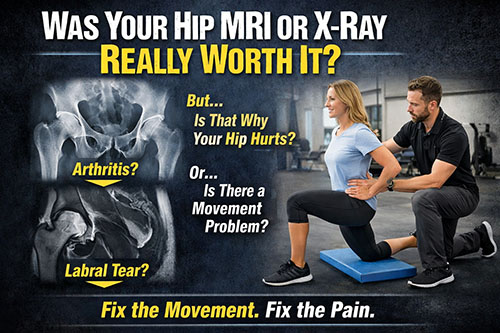
Was Your Hip MRI or X-ray Really Worth It?
You finally got the imaging. After weeks—or months—of hip pain, your doctor ordered an MRI or X-ray. You were hoping for clarity. Answers. A clear path forward.
Instead, you got a report filled with terms like labral tear, arthritis, degeneration, or even the dreaded “bone-on-bone.”
But here’s the question few people ask: Did that imaging actually tell you why your hip hurts?
The Problem with Hip Imaging
Modern imaging is incredibly advanced. MRIs and X-rays can reveal detailed pictures of your bones, cartilage, and soft tissues.
But here’s the catch: They show structure—not function.
And pain is far more about how your body moves than what it looks like on a scan. Research has consistently shown that many people with: Labral tears, Hip arthritis, Cartilage wear…have no pain at all.
At the same time, others with severe hip pain may show only mild—or even completely normal—imaging findings.
So what does that mean? It means your diagnosis may describe what is present, but not what is causing your pain.
When a Diagnosis Isn’t the Root Cause
Let’s say your MRI says you have a labral tear. That sounds serious. But here’s the deeper question:
Why did that area become overloaded in the first place?
Your hip doesn’t operate in isolation. It’s part of a complex, interconnected system involving:
-
Your foot and ankle
-
Your knee
-
Your pelvis
-
Your spine
If any part of that system isn’t moving well, your hip often becomes the “compensation zone.”
Over time, that compensation leads to increased stress, tissue irritation, and pain.
And eventually… changes that show up on imaging.
But the MRI may be showing you the result of the problem—not the source of it. And if the underlying movement dysfunction isn’t addressed, the problem simply comes back.
A Different Approach: Applied Functional Science
This is where Applied Functional Science (AFS) physical therapy changes everything.
Instead of asking:
“What does your MRI show?”
We ask:
“How does your body move?”
An AFS physical therapist performs a detailed movement assessment, analyzing how your body functions in real-life activities like:
-
Walking
-
Rotating
-
Bending
-
Reaching
-
Stepping
This reveals something imaging never can: Where your movement system is breaking down.
Finding the Real Cause of Hip Pain
Using this approach, we often uncover issues like:
-
Limited ankle mobility forcing the hip to compensate
-
Poor rotational control through the pelvis
-
Weak or delayed muscle activation patterns
-
Asymmetrical loading during everyday movements
These dysfunctions create abnormal stress on the hip joint—regardless of what your imaging shows.
And here’s the key: When you fix the movement, you remove the stress.
When you remove the stress, the body can heal.
Why This Approach Works—Even If Imaging Looks “Bad”
One of the most empowering things patients discover is that your imaging does not define your outcome.
You can have:
-
Arthritis and feel great
-
A labral tear and move pain-free
-
“Bone-on-bone” findings and avoid surgery
Because pain is not dictated solely by structure—it’s driven by how forces move through your body.
Applied Functional Science therapy restores:
-
Proper joint mechanics
-
Balanced force distribution
-
Efficient movement patterns
This reduces irritation and allows tissues to recover naturally.
From Temporary Relief to Lasting Change
Traditional approaches often focus on:
-
Rest
-
Medication
-
Injections
-
Surgery
These can reduce symptoms—but they don’t necessarily solve the underlying issue.
AFS physical therapy is different.
It’s designed to:
-
Identify the true source of dysfunction
-
Restore natural movement
-
Build resilience and strength
So you’re not just feeling better. You’re moving better.
And that’s what creates lasting results.
So… Was It Worth It?
Your MRI or X-ray wasn’t useless. It can rule out serious conditions and provide helpful context.
But if it didn’t lead to a clear, lasting solution for your pain, it didn’t give you the full picture.
Because the most important information isn’t found in a static image. It’s found in motion.
If you’re still dealing with hip pain
The answer may not be in the scan. It may be in how your body moves.
Don’t just manage hip pain. Fix the reason it started.
Find out when our next FREE Hip Workshop is and how you can participate here: https://www.thesuperiortherapy.com/hippainrelief
And get your FREE copy of the book, The Truth about Hip Pain by Dr. Andrew Gorecki and Dr. Ben Fuson here: https://www.thesuperiortherapy.com/hipbook