 (231) 944-6541
 West:
West: 
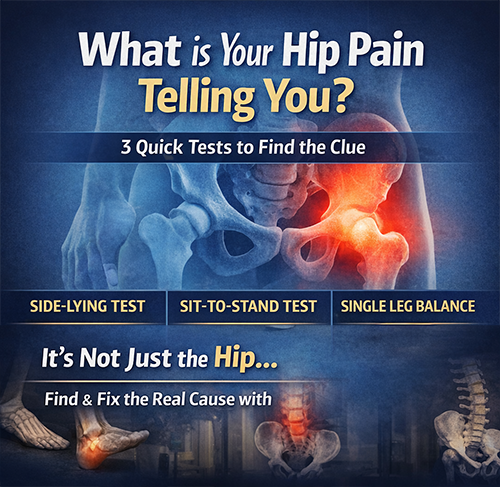
3 Simple Self-Tests to Understand Your Hip Pain—And What to Do About It
Hip pain can feel confusing. Is it coming from the joint? The muscles? The tendons? Or something else entirely?
While a true diagnosis should always come from a qualified professional, there are a few simple self-tests you can do at home to better understand the type of hip pain you may be dealing with. This can help guide smarter decisions—and avoid unnecessary treatments.
Self-Test #1: The Side-Lying Pressure Test (Possible Bursitis)
How to do it:
-
Lie on your painful side on a firm surface (like a bed or floor).
-
Stack your legs and relax.
What to look for:
-
Sharp, localized pain on the outside of your hip
-
Pain that makes it difficult to stay in this position for more than a few seconds
What it may indicate:
This often points to irritation of the bursa on the outside of the hip (commonly called trochanteric bursitis). The bursa is a fluid-filled cushion designed to reduce friction—but it can become sensitive when overloaded.
Key insight:
The bursa is usually not the root problem—it’s the victim of poor movement mechanics and repeated stress.
Self-Test #2: The Sit-to-Stand Test (Joint or Deep Hip Involvement)
How to do it:
-
Sit in a chair with your feet flat on the ground
-
Stand up without using your hands
-
Sit back down slowly
-
Repeat 5–10 times
What to look for:
-
Deep groin pain or stiffness
-
Pain that eases after a few repetitions
-
A feeling of “catching” or pinching
What it may indicate:
This pattern often suggests involvement of the hip joint itself (such as early arthritic changes or joint irritation).
Key insight:
Pain that improves with movement is often a sign that the joint needs better motion, not less.
Self-Test #3: The Single-Leg Balance Test (Muscle & Tendon Control)
How to do it:
-
Stand on one leg (the painful side)
-
Try to hold your balance for 20–30 seconds
What to look for:
-
Pain on the outside of the hip during the test
-
Your pelvis dropping on the opposite side
-
Difficulty maintaining balance
What it may indicate:
This may point to weakness or poor coordination of the hip stabilizers (especially the gluteal muscles), which can lead to tendon irritation over time.
Key insight:
Hip pain is often a control problem, not just a strength problem.
Why These Tests Matter
Each of these tests gives you a clue—but none of them exist in isolation.
Your body is not a collection of separate parts. It’s a connected, dynamic system. Pain in the hip is often influenced by how your foot, knee, pelvis, and even your upper body are moving together.
This is where most traditional approaches fall short.
How Applied Functional Science Physical Therapy Solves the Root Problem
Applied Functional Science (AFS) physical therapy looks beyond the site of pain and asks a more important question:
“Why is this tissue being overloaded in the first place?”
Instead of treating bursitis, tendonitis, or joint pain as isolated diagnoses, AFS examines how your body moves in real life—walking, rotating, bending, and reaching.
What Makes This Approach Different
1. It Identifies the True Source of Stress
Your hip pain may actually be driven by limited ankle mobility, poor pelvic control, or restricted rotation elsewhere in your body.
2. It Uses 3D Movement
The body doesn’t move in straight lines—and your therapy shouldn’t either. AFS uses multiplanar movements that reflect real-life demands.
3. It Treats the Cause, Not Just the Symptoms
Instead of calming the bursa or tendon temporarily, treatment restores proper load distribution so the tissue can heal and stay healthy.
4. It Builds Resilient Movement
You don’t just feel better—you move better, which reduces the chance of the pain returning.
Hip pain is rarely as simple as the label it’s given.
Bursitis, joint pain, and tendon irritation are often signals, not root causes.
These self-tests can give you insight—but real, lasting relief comes from addressing how your body moves as a whole.
That’s exactly what Applied Functional Science physical therapy is designed to do.
If you’ve been told to rest, avoid activity, or consider injections or surgery, there may be a better path forward. One that helps your body heal by restoring the way it was designed to move.
Find out when our next FREE Hip Workshop is and how you can participate here: https://www.thesuperiortherapy.com/hippainrelief
And get your FREE copy of the book, The Truth about Hip Pain by Dr. Andrew Gorecki and Dr. Ben Fuson here: https://www.thesuperiortherapy.com/hipbook