 (231) 944-6541
 West:
West: 
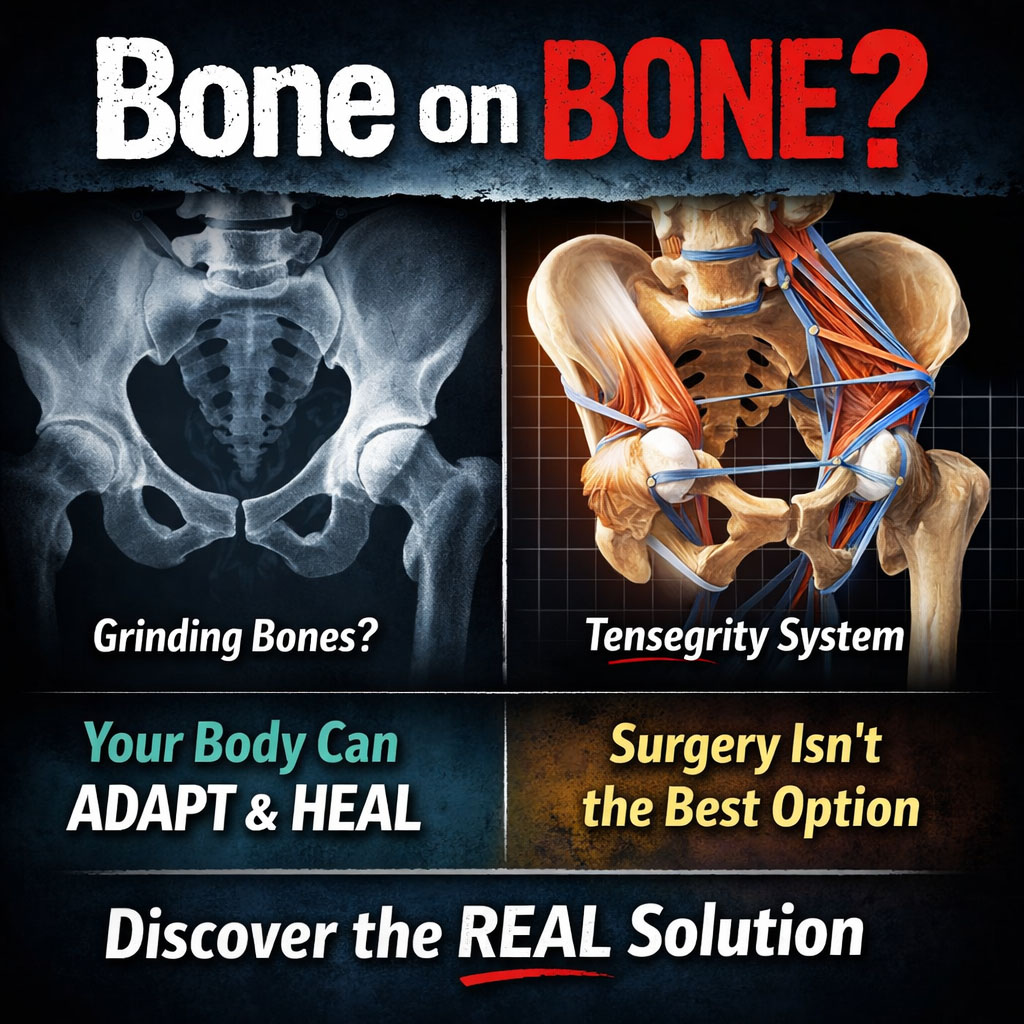
Dispelling the Myth of Hip “Bone on Bone” with Biotensegrity
If you’ve ever been told you have “bone on bone” in your hip, you’re not alone. It’s one of the most common—and most alarming—phrases patients hear after an orthopedic consultation. The implication is clear: the joint is worn out, cartilage is gone, and the only real solution is replacement.
But what if that explanation is incomplete?
What if the way we understand the human body—particularly the hip joint—is due for an upgrade?
Let’s take a closer look through the lens of biotensegrity and modern movement science.
The Problem with the “Bone on Bone” Diagnosis
Orthopedic imaging—like X-rays—can show reduced joint space, changes in bone shape, or signs of arthritis. These findings are often interpreted as bones rubbing directly against each other.
But here’s the issue:
-
X-rays are static images of a dynamic system
-
They do not show soft tissue behavior, force distribution, or movement patterns
-
They cannot capture how your body actually functions during walking, golfing, or daily life
In fact, many people with “severe” imaging findings have little to no pain… while others with minimal changes experience significant discomfort.
So what’s really going on?
Enter Biotensegrity: A Different Way to Understand the Body
The concept of biotensegrity, pioneered by Dr. Stephen Levin and further explored by researchers like Graham Scarr, offers a radically different perspective.
Instead of viewing the body as a stack of bones compressing into each other, biotensegrity describes a system where:
-
Bones are suspended within a continuous network of tension
-
Muscles, fascia, ligaments, and tendons distribute forces throughout the body
-
Compression is minimal and balanced—not localized and destructive
In this model, the hip joint is not a grinding hinge.
It is a floating structure, stabilized and guided by a dynamic web of soft tissues.
Key Insight:
Bones don’t simply “touch and wear out”—they are held apart, supported, and controlled by tension throughout the entire system.
Why Pain Happens (If It’s Not Just “Bone on Bone”)
If bones aren’t truly grinding together, then why does hip pain occur?
From a biotensegrity and applied functional science perspective, pain is more often related to:
-
Movement dysfunction
-
Imbalanced force distribution
-
Loss of mobility in surrounding joints (ankle, knee, spine)
-
Poor load management during real-life activities
When the body loses its ability to efficiently distribute forces, certain tissues become overloaded. Over time, this can lead to irritation, inflammation, and pain.
This is a functional problem—not just a structural one.
And functional problems can be improved.
The Role of Applied Functional Physical Therapy
Applied Functional Science (AFS) physical therapy—developed through the Gray Institute—approaches the body as an integrated, three-dimensional system.
Rather than focusing only on the hip joint itself, AFS looks at:
-
How the foot interacts with the ground
-
How the knee, hip, and pelvis coordinate
-
How the spine and upper body contribute to movement
-
How forces are absorbed, transferred, and generated
What This Means for Patients
Instead of being told to “avoid movement” or prepare for surgery, patients are guided through:
-
Purposeful, real-world movement patterns
-
Multi-directional exercises (not just straight-line strengthening)
-
Progressive loading to restore tissue tolerance
-
Mobility and stability training across the entire kinetic chain
This approach doesn’t just mask symptoms—it addresses the underlying cause of dysfunction.
Can Hip Pain Really Improve Without Surgery?
In many cases, yes.
Even when imaging shows advanced changes, patients can:
-
Reduce or eliminate pain
-
Improve mobility and strength
-
Return to activities like walking, golfing, or exercising
-
Delay or completely avoid hip replacement surgery
Why?
Because pain is not determined solely by what an image shows.
It is influenced by how well your body moves, adapts, and distributes force.
Reframing the Narrative
The phrase “bone on bone” creates a sense of finality—as if the body is broken beyond repair.
But the human body is not a worn-out machine.
It is a dynamic, adaptable system.
Biotensegrity reminds us that:
-
The body is interconnected
-
Structure and function are inseparable
-
Movement is medicine
A More Hopeful Path Forward
If you’ve been told your hip is “bone on bone,” it doesn’t have to be the end of the story.
With the right approach—one that respects the body’s design and leverages its ability to adapt—you may have more options than you’ve been led to believe.
Applied functional physical therapy offers a path that is:
-
Restorative rather than restrictive
-
Empowering rather than limiting
-
Focused on what your body can do, not just what an image shows
Your hip is not just a joint—it’s part of a living, responsive system.
And when that system is trained, guided, and supported properly…
Healing becomes possible.
Resources:
Learn more about the concept of Biotensegrity and Stephen M Levin at: https://www.biotensegrity.com/
Find out when our next FREE Hip Workshop is and how you can participate here: https://www.thesuperiortherapy.com/hippainrelief
And get your FREE copy of the book, The Truth about Hip Pain by Dr. Andrew Gorecki and Dr. Ben Fuson here: https://www.thesuperiortherapy.com/hipbook